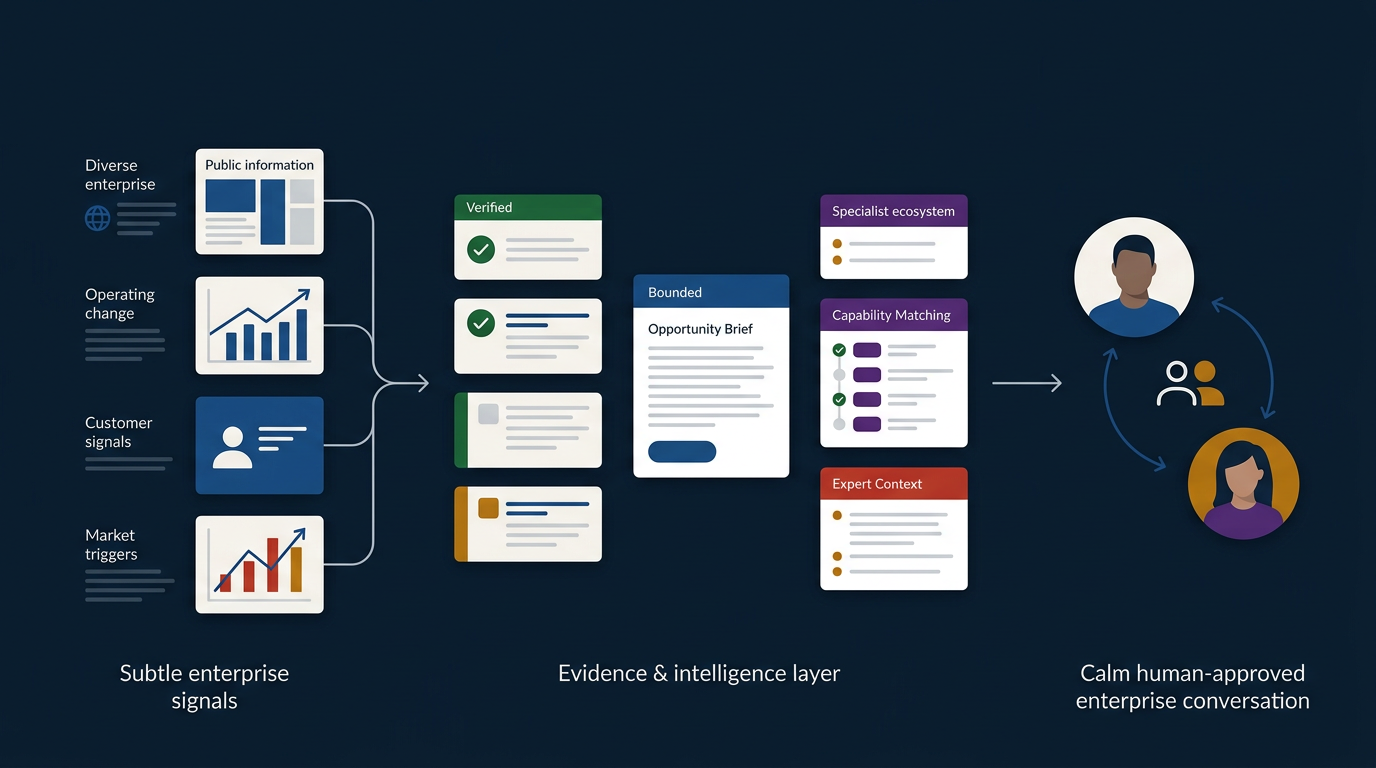
Avrozen Perspectives examines the signals, operating constraints and solution patterns that shape CME, BFSI and Utilities innovation before a formal RFP exists.
Follow the research
One note a month on the signals, constraints and solution patterns shaping CME, BFSI and Utilities before an RFP exists. No product announcements, no sales follow-up. Unsubscribe in one click.
By following you agree to receive the monthly note. We record the date of your consent and nothing else. See the Privacy Policy.
Enterprise IntelligenceSeptember 2026
Why enterprise innovation starts before the RFP
Procurement is a late signal. The organisations that move earliest do so because they have structured intelligence before the formal process begins. This article examines what pre-RFP intelligence looks like in practice and why it matters for CME, BFSI and Utilities decision-makers.
AI in BFSI: where the value is real without putting regulated decisions on autopilot
AI can improve research, matching and drafting in financial services. It should not replace human authority at regulated, consequential steps. This article examines where AI adds genuine value in BFSI and where human control must remain.
Agentic AI can automate complex workflows, but high-impact and regulated decisions must stay under human control. This article outlines a practical governance model for deploying agents safely in CME, BFSI and Utilities contexts.
Most enterprise deals stall because conversations start too late and too vaguely. This article outlines a disciplined model to move from market signal to a qualified, evidence-based conversation before procurement takes over.
Why Telecom operators need specialist AI procurement, not platform procurement
Telecom operators that procure AI as a platform capability often find that the platform solves the wrong problem. This article examines why specialist procurement — scoped to a bounded operating problem — consistently outperforms broad platform selection in Telecom contexts.
AI governance in BFSI: a practical framework for regulated environments
Governance is not a constraint on AI adoption in financial services — it is the condition that makes adoption sustainable. This article sets out a practical governance framework for BFSI organisations deploying AI in regulated workflows.
The evidence gap: why most enterprise AI projects start with the wrong problem
Enterprise AI projects fail not because the technology is immature but because the problem is poorly defined at the outset. This article examines the evidence gap — the distance between a felt operating pain and a well-scoped, evidence-validated problem statement — and how to close it.
Agentic AI is not automation: understanding the distinction that matters for enterprise
Automation executes defined rules. Agentic AI reasons, plans and acts across multi-step workflows. The distinction matters enormously for how enterprises govern, deploy and measure AI — and for which problems each approach is suited to solve.
Why domain experts are the missing layer in enterprise AI deployments
Most enterprise AI deployments have strong technology and weak domain grounding. The result is solutions that are technically sound but operationally irrelevant. This article examines the role domain experts play in bridging that gap — and why their involvement at the evidence stage, not the delivery stage, is what changes outcomes.